Table of Contents
ToggleWhat is Federalism?
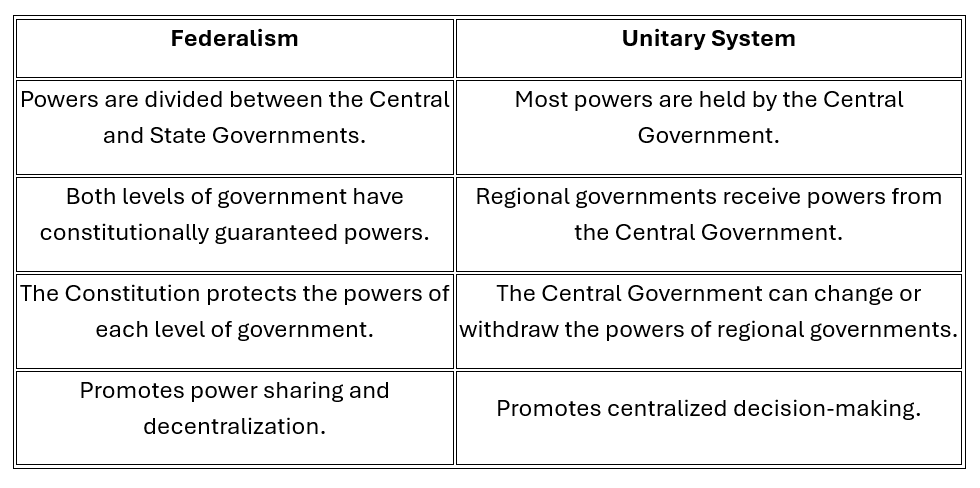
Federalism is a system of government in which the power is divided between a central authority and various constituent units of the country.
*Opposite of Federalism: Unitary System:
The opposite of Federalism is the Unitary System of Government.
In a Unitary System, all major powers are concentrated in one Central Government. Regional or local governments (if they exist) function under the authority of the Central Government and do not enjoy constitutionally protected powers like in a federal system.
FEATURES OF Federalism?
1. Two or More Levels of Government
A federal system has two or more levels of government, and all of them govern the same citizens.
In India: There are three levels of government—the Union Government, State Governments, and Local Governments (Panchayats and Municipalities).
2. Separate Jurisdiction
Each level of government has its own jurisdiction, which means it has the authority to make laws and take decisions on specific subjects.
In India: The Constitution divides powers through the Union List, State List, and Concurrent List, so every level knows its responsibilities.
3. Constitutional Protection
The powers and authority of each level of government are clearly mentioned and protected by the Constitution.
In India: Neither the Union Government nor the State Governments can take away each other’s constitutional powers without following the Constitution.
4. Rigid Constitution
The fundamental provisions of the Constitution cannot be changed by only one level of government. Such changes require the consent of both levels.
In India: Certain Constitutional Amendments require approval by Parliament as well as at least half of the State Legislatures.
5. Independent Judiciary
The courts interpret the Constitution and settle disputes between different levels of government.
In India: The Supreme Court acts as an independent umpire and resolves disputes between the Union and the States.
6. Separate Sources of Revenue
Each level of government has its own sources of revenue to perform its functions independently.
In India: Both the Union and State Governments collect taxes and receive funds according to constitutional provisions.
7. Dual Objectives of Federalism
Federalism has two main objectives—to protect the unity of the country and respect its diversity. It works on the principles of mutual trust and agreement between different levels of government.
In India: The Union and State Governments work together to maintain national unity while respecting the country’s regional, linguistic, and cultural diversity.
Types of Federation
Federations are formed in two different ways depending on how the federation was created.
1. Coming Together Federation
A Coming Together Federation is formed when two or more independent states voluntarily come together to establish a larger nation.
In this type of federation, the Central Government and the State Governments generally enjoy equal constitutional status, and the states remain strong partners in the federation.
Examples: USA, Switzerland and Australia.
2. Holding Together Federation
A Holding Together Federation is formed when one large country divides its powers between the Central Government and the State Governments.
Unlike the Coming Together model, the Central Government is generally more powerful than the State Governments. Also, all states may not have identical powers, as some regions can be given special constitutional provisions.
India follows the Holding Together model of Federation. Spain and Belgium are other examples of this type.
What Makes India a Federal Country?
Although the word “Federal” is not explicitly mentioned in the Indian Constitution, India has a federal system of government because the Constitution divides powers between different levels of government and provides constitutional status to each level.
The federal structure of India is mainly reflected through:
- Three-Tier Government
- Three Lists (Division of Powers)
Three-Tier Government
1. Union (Central) Government
The Union Government deals with matters related to the entire country and takes decisions on issues of national importance.
2. State Government
The State Government looks after matters related to a particular state and works for the welfare and development of its people.
3. Local Government
The Local Government manages local issues and provides basic civic services at the grassroots level.
- Rural Areas: Panchayats
- Urban Areas: Municipalities
The 73rd and 74th Constitutional Amendments (1992) gave constitutional status to Local Governments, making India a three-tier federation.
Three Lists
To ensure a clear distribution of responsibilities, the Indian Constitution divides subjects into three lists under the Seventh Schedule.
1. Union List
Contains subjects of national importance on which only the Union Government can make laws.
Examples: Defence, Foreign Affairs, Banking and Currency.
2. State List
Contains subjects related to the administration of individual states on which only the State Governments can make laws.
Examples: Police, Agriculture and Public Health.
3. Concurrent List
Contains subjects on which both the Union and State Governments can make laws.
Examples: Education, Forests and Trade Unions.
# NOTE: If there is a conflict between a Central law and a State law on a Concurrent List subject, the Central law prevails.
#Residuary Subjects
Residuary Subjects are those subjects not included in the Union List, State List or Concurrent List. The power to make laws on these subjects rests with the Union Government.
Example: Cyber laws, Digital Technology and Artificial Intelligence were not originally listed in the Constitution, so they fall under Residuary Subjects.
Important Facts:
- Federal Word: Not explicitly mentioned in the Indian Constitution.
- Federal Nature: India has a federal system with a strong Centre.
- Federal Model: Holding Together Federation.
- Inspired From: Constitution of Canada.
- Constitutional Identity: Article 1 – “India, that is Bharat, shall be a Union of States.”
- Guardian of Federalism: Supreme Court of India.
- “India is a Quasi-Federal Country”: said by K.C. Wheare.
- Reason for Quasi-Federal: Combination of federal and unitary features with a strong Centre.
- Gandhiji’s Vision: Democracy should begin at the village level.
How is Federalism Practised in India?
The success of federalism in India can be understood through three important measures:
- Linguistic States
- Language Policy
- Centre–State Relations
Linguistic States
After Independence, the demand for reorganising states on the basis of language became stronger. In 1948, the Government appointed the Dhar Commission, which did not recommend the creation of linguistic states.
However, due to growing public demand, the States Reorganisation Act, 1956 reorganised the boundaries of most states mainly on the basis of language.
Language Policy
India follows a flexible and inclusive language policy to respect its linguistic diversity.
- Hindi is the Official Language of the Union.
- English continues to be used for official purposes along with Hindi.
- The Constitution recognises 22 Scheduled Languages in the Eighth Schedule.
- Every State is free to adopt its own official language for administration.
Unlike some countries, India does not have a National Language.
Centre–State Relations
The Indian Constitution creates a federal system with a strong Centre.
Earlier, the same political party often governed both the Centre and most States. Later, the rise of regional parties and coalition governments increased the participation of States in national decision-making.
Today, important decisions are taken through consultation, cooperation, and coordination, making Indian federalism stronger.
Decentralisation in India
Decentralisation means the transfer of powers, responsibilities, and resources from the Central and State Governments to Local Governments.
A major step towards decentralisation was taken through the 73rd and 74th Constitutional Amendment Acts, 1992, which came into effect in 1993.
- 73rd Constitutional Amendment Act → Introduced the Panchayati Raj System in rural areas.
- 74th Constitutional Amendment Act → Established Municipalities in urban areas.
Advantages of Decentralisation
- Brings government closer to the people.
- Encourages people’s participation.
- Ensures quick decision-making.
- Improves transparency and accountability.
- Promotes grassroots democracy.
- Addresses local needs more effectively.
- Strengthens local self-government.
- Improves implementation of government schemes.
- Reduces the workload of the Central and State Governments.
- Encourages local leadership and development.
Limitations of Decentralisation
- Lack of financial resources in some local bodies.
- Limited administrative powers in certain areas.
- Political interference in local governance.
- Lack of trained officials and technical staff.
- Unequal development among different regions.
- Delay in implementing development projects.
- Misuse of funds in some cases.
- Lack of public awareness and participation in some areas.
Panchayati Raj System
The Panchayati Raj System is the system of local self-government in rural areas.
It has a three-tier structure:
- Gram Panchayat – Village Level
- Panchayat Samiti – Block (Intermediate) Level
- Zila Parishad – District Level
The Gram Sabha is the foundation of the Panchayati Raj System. It consists of all adult voters of a village and plays an important role in approving plans and reviewing the work of the Gram Panchayat.
The Gram Panchayat is headed by a Sarpanch, while its members are called Panchs. They are directly elected by the people for a five-year term.
To ensure equal participation, seats are reserved for Scheduled Castes (SCs), Scheduled Tribes (STs), and OBCs according to state laws. At least one-third of the total seats and chairperson posts are reserved for women.
Municipalities
Municipalities are the local self-government institutions in urban areas.
Depending on the size of the urban area, local bodies are organised as:
- Nagar Panchayat – Transitional Areas
- Municipal Council – Smaller Towns
- Municipal Corporation – Large Cities
Like Panchayats, the members of Municipalities are directly elected for a five-year term, and seats are reserved for SCs, STs, OBCs, and women as provided by the Constitution and state laws.